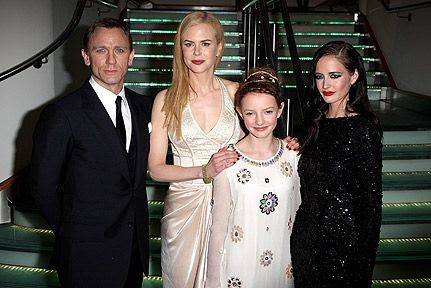
Tuesday, January 12, 2021

The Golden Compass 2007 Retrospective


If the Lyra Belacqua of His Dark Materials could be successfully captured or distilled into a single scene - or even gesture - said scene shows up in the final act of the 2007 Golden Compass film. 

To set the stage, the action is taking place outside of Bolvangar, the dreaded hidden laboratory in the deep Arctic. The authoritarian Magisterium has been experimenting on kidnapped children, which our young heroine has just freed. Upon escaping the facility, Lyra and the kids find themselves confronted by rows and rows of fully grown, ferocious Tartar soldiers and their fully grown, even more ferocious wolf-daemons. 

In the film, our brave little Lyra defiantly steps forward and spits at the feet of the heavily-armed, war-loving mercenaries, expressing her bravado and contempt. 

It is moments like this that persistently edge this film into my heart, and this very scene can be viewed in the first forty seconds of this clip here

Most of us know at least some of the behind-the-scenes drama and eventual fate of The Golden Compass film adaptation. No doubt looking for another British fantasy trilogy to step up to the plate after the enormous success of The Lord of the Rings, New Line Cinema acquired the rights to bring the His Dark Materials novels to the big screen. 

At this point, the books had won award after award, sold millions of copies all over the world, and were quickly becoming classics of children's literature. While producers like Deborah Forte seemed to be genuinely passionate about the potential of a serious and sincere adaptation, in the end New Line was unfortunately rather oblivious regarding what exactly they had on their hands, and never fully understood or appreciated the property.

Still, the first novel in the series, respectively known as The Golden Compass in the U.S. and Northern Lights in the U.K., was successfully filmed and then released in December of 2007, but many feel it never lived up to its literary potential. The reasons are complicated, as this post will explore. For one, while TGC performed well overseas, the studio was banking on a huge stateside box office, which didn't materialize. Overall, it opened here to what was considered lackluster ticket sales and mixed reviews

This wasn't helped by the controversy surrounding the film, particularly its perceived irreligious sentiments. As overblown as it may seem now, various conservative groups managed a fairly competent boycott, at least in the U.S. I personally remember the tone of the discussions on the Bridge to the Stars fan forums at the time, which were not short on irony or humor. 

They rightly called out the most belligerent of these groups, the Catholic League, for its rather blatant hypocrisy. The League's primary message seemed to be that they believed the film had an agenda, and that children should never be exposed to anything with an adult agenda because they weren't intellectually or emotionally mature enough to recognize the truth for themselves. 

Just ponder that one for a second, as well as the normal institutional attitude toward children and agendas. Ironic indeed. 

Though famed writers like Tom Stoppard were originally attached to the production, Chris Weitz was eventually hired to write and direct the film. It is also sadly necessary to point out here that the studio ultimately took the movie away from him though, insisting that the ending be cut and finally omitted altogether. As some of those scenes are the most powerful in the novel, in my opinion this went the furthest in finally sabotaging the film, and leaving many with an unsatisfying experience. 

This likewise ensured the two other books in the trilogy would not be adapted on the big screen, and left fans and filmgoers alike with a truncated movie within a truncated epic. 

As for the author, Philip Pullman has always appeared quite congenial and easygoing when it comes to adaptations of his work. At this point, His Dark Materials has been translated into everything from graphic novels to stage plays to audio narrations. And as he is fond of pointing out, his original, unaltered novels are still right there on the book shelf, waiting and primed to be read. 

In the years to follow, Pullman has criticized TGC as a "movie without an ending," and I recently discovered an interview in the Guardian in which he faults some of the design elements as too "twiddly" or fantastical for his tastes, particularly the armor of the ice bears. Other than that, he rarely comments on the film now, and when he does, it's primarily to still praise the "excellent" cast. 

But more on all of this later. As should be clear, there is no shortage of opinions on this particular work of film, and it is time for me to explore mine. I do feel the film is owed a genuine reevaluation, and one by a sincere devotee of the books. 

As my readers know, much of the imaginative real estate of this blog is rooted and grounded in poetry - therefore it is only fitting and honest fitting to admit how I sometimes work as a consumer (and even connoisseur) of content and narrative. Once I had to articulate this to someone else, I understood it much better myself. I call it the EDP, and it is perhaps quite relevant to my own enjoyment and evaluation of The Golden Compass film. 

Emily Dickinson once famously said that she intuitively knew something was poetry "If I physically feel as if the top of my head were taken off." I have adopted that sentiment, and have taken to using it to describe the way I feel about certain works of popular art or fiction. It's a little bit more memorable than maybe saying something as potentially trite as "You know it when you see it."

In other words, even if something may be flawed, even if it can be easily criticized .... well, I sometimes don't really care, simply because it feels so right. It matches up thoroughly with my own interior geography, and something in me reflects something in it, or vice versa. And much like with Emily, I don't think it's simply an emotional response, because it seems deeper and more intuitive and truer than that. 

So while it may not entirely take my proverbial head off, I retain a very soft spot for TGC film. Imperfect or no, it simply feels very much like the world(s) I fell in love with while reading the book(s). Therefore I must strongly invoke the Emily Dickinson Principle in this case, as the images splashed across the screen are so similar to the ones conjured up by Pullman's prose. At least in my head and during my reading experience. 

All the flaws in the world can't truly compete with that, but still I will try to make a reasonable case for why the film is worth the time of other book lovers.

While I seem to recall that the person I went with that opening week wasn't all that taken with the movie, to this very day I can remember what a little thrill it was for me to finally see Lyra and Mrs. Coulter and Lord Asriel and Lee Scorseby and Serafina Pekkala all brought to life on a magnificently big screen. 

Obviously, condensing an almost four hundred page novel into a two hour movie was always going to be a formidable task, but still so many elements are there. And while the shape and structure may get a little wobbly, the novel's story is there too. All of it is framed with the necessary cinematic shorthand, but I feel even some of the basic themes and such are illustrated fairly well. 

From the visual prologue alone, audiences win some neat deep space images courtesy of the Hubble telescope, tying in the story with the deeper cosmic mysteries of Dust. Then the camera glides from one alternate world to the next, guided through several veiled and flickering passages presumably cut with a subtle knife and hanging on the fabric of reality itself. And then a brief introduction to Lyra's world, a corner of the multiverse teeming with beings like daemons and witches and sentient ice bears. 

While Pullman made later comments critiquing some of the film's heightened look or fancifulness, at the film's premiere at the Odeon, he was very free with his praise. He unhesitatingly said the film looked "wonderful," and on the special features he repeatedly complimented things like the costuming choices. For me, the film's imagery of an alternate Brytain is largely what I envisioned whether the author or other readers did or not. 

First off, some of the the cinematography is really rich and lush and beautiful, from the buildings and rooftops of Oxford all the way to the icy, frozen plains of the North. This is a film unafraid of color and lavish hues, and for me it helps establish the slightly-alternate style of the world, a world with a history that occasionally forked left when our own veered right. 

I personally do not see a lack of color or visual splendor as a plus when I view a film, so maybe that's another reason I fall so easily under this one's spell.


Granted, even I could probably have done without the whimsical, so called "anbaric carriage" Lyra rode in to Mrs. Coulter's home in London. Still, some of the framing and establishing shots inch toward painterly at times, and my eye naturally gravitates to that sort of thing. And something like the great airships are really pretty impressive (one can't really have an alternate world without zeppelins, am I right?). 

Though His Dark Materials is set in its own late twentieth century, the design the filmmakers embraced was largely that of a Victorian aesthetic and architecture, only pushed forward a century or two. With some sprinkles of art deco and art nouveau scattered about for good measure. To me, it produced a charming and unique hybrid of the higher tech with the older fashioned, with a world still rooted more in the hand crafted than in the mass produced. 

The production design really shines when boiled down to specific objects or artifacts, most notably the alethiometer, the signature truth-telling device capable of "interrogating the universe," as Pullman has put it. As props go, it is undeniably the most important, as it even incorrectly ties in with the very title of The Golden Compass, a mistake that seems to haunt every U.S. adaptation. 

Here is a nice clip as Lyra and the gyptians explore its strange, numinous qualities. 


Clearly, the end result in the film is an ornate, unique, captivating instrument - and again, an imaginative marriage of the mystical and the functional, the digital and the real. It was very important to writer-director Weitz to imbue the alethiometer with a weight and a tangibility, with a style scoured from medieval books, and engraved with Latin inscriptions and alchemical symbols. 

Perhaps most impressively, the alethiometer was narratively forged in Prague in the 1600s, so the real world prop makers ensured it was marked out with symbolism unique to that region. 

Another crucial piece of this cinematic puzzle is the daemons, the animal representations of a person's deepest self or personality. Visually bringing all of this to life was a daunting task, and Weitz was adamant he didn't want any of the scenes turning into a zoo. Though the CGI by Rhythm and Hues is maybe growing dated, again, the basic feel and integrity of the human-daemon bond is very much represented and on point. 

Check our this excellent video on Defining Daemons

Pullman memorably noted in the small novella Lyra's Oxford that if a cat encountered a cat-daemon, they would not see another cat - they would see a human being. This is hard to convey cinematically, but part of the horrors of "severing" and the Oblation Board is that daemons are not separate creatures, much less animals. A human and a daemon are one complete being. Therefore I was impressed to hear Weitz remark on the movie commentary that he didn't see daemons "as effects but as people." 

The challenge of relating all this information visually had to have been daunting, but the human-daemon interactions in the film reflect this reality surprisingly well. One early scene at Oxford opens with Lord Asriel's snow leopard-daemon Stelmaria carrying Lyra's daemon Pantalamion in its mouth, the pair immediately being followed by Asriel pulling Lyra into frame by the arm. Seconds later, Asriel and Lyra have a verbal confrontation, while their respective daemons snarl and growl and Pan adopts the form of an angry cat. 


And I'll always be fond of the visual cue later in Trollesund as Lee Scoresby and his hare-daemon Hester both inquisitively and simultaneously cock their heads to the side. 


The unnamed Golden Monkey is another standout in the daemon department. The scene in the Jordan dining hall with Mrs. Coulter seducing Lyra above the table while the Monkey strokes and manipulates a slightly wary Pan under it comes to mind. As does the scene where Lyra later escapes into London, slamming a window shut behind her, catching the Monkey's paw and Mrs. Coulter storming into the shot while massaging her own clearly wounded hand. 


But aside from the production and the sets and the effects and all the rest, let's move on to the one feature of the film that gets almost universal acclaim - or at least sometimes grudging admiration. As referenced earlier, even now, barely can a mention of the film be made around Pullman without him singling out and soundly praising the magnificent cast. 

From my own perspective, it is as if the characters effortlessly strolled off the pages of Northern Lights and onto the screen of TGC. And as they have consistently been some of my favorite characters in literature, that was no small feat. Forget the prodigious talent of the actors on display - for me it was largely about the simple embodiment of said characters in another, profoundly visual medium. 


There is only one real place to begin, as newcomer Dakota Blue Richards basically steals the show. Though a mere twelve years old at the time, she carries this movie, and barely a scene goes by that doesn't heavily feature her prodigious talents. She doesn't just play a character named Lyra Belacqua - she channels her throughout the story. 

The little whirlwind of life and energy that is Lyra is one of the most beloved characters in young literature, and Richards spins through her scenes with a kind of inexhaustible energy. Like her fictional counterpart, she is at times childish, adolescent, adult, wild, savage, sweet, loving, furious, loyal, devious, petulant, rebellious, brave, daring, cunning, or whatever the script and the story calls for. But as Lyra she is always animate and aware and keenly alive, and was repeatedly singled out for her acting by such critical heavyweights as TIME magazine. 

Despite having no more acting experience than a school play or two, Richards impressively holds her own against the rest of the cast, whether it be with Daniel Craig and Nicole Kidman or a stuffed dummy standing in as her on-set daemon. We so believe in all the daemons and alethiometers and talking bears because she does. 

And if someone disagrees, well, they probably haven't made it down this far anyway. 

One scene in the third act particularly stands out, as Lyra is confronting the fraudulent bear-king Ragnar Sturlusson (and Ian McShane does such a fun and ferocious job with the growly voice I don't even mind the name was altered from Iofur Raknison). As the king is clearly infatuated with Mrs. Coulter, Lyra channels some of her mother's endless wiles, and essentially seduces him. 

Weitz remarks on the commentary that it's kind of an odd scene, with a "young girl flirting with an adult bear," but Richards plays it out as flawlessly in the film as Lyra did in the actual novel. Check out the clip of the scene here


Speaking of Mrs. Coulter, Nicole Kidman is equally as perfect in her role. Naturally beautiful and beguiling, Kidman brings the perfect aura of charm, grace, mystery, complexity, and straight up evil to the part. She plays the role with the same cool command and icy demeanor as her character, breaking that persona only when she needs to twist and manipulate, as she is capable of doing with basically everyone. Her passions and emotions are rarely outwardly channeled through anything but her terrible, mute monkey-daemon. 

Apparently Kidman had already read the trilogy years before being cast, as she had been tipped off early regarding the interest already building in her playing the role. True, she is blonde rather than brunette, but when everything else is this perfect, I'll have to invoke the EDP again. And actually, Pullman himself voiced his desire for her to be cast as Coulter, and has since admitted his deepest film regret was that Kidman was never allowed to follow the character through her dramatic growth and surprising transformation in later books. 

Interestingly, Pullman even penned a new scene in the script when Coulter slaps her own daemon in a moment of personal turmoil while searching for Lyra. 

Watch Mrs. Coulter's iconic entrance here


Just as not many men could be intellectually and emotionally powerful enough to partner with Mrs. Coulter, so few actors could be capable of holding their own in scenes with Nicole Kidman. Fortunately we have Lord Asriel in that regard, and Daniel Craig to play him. 

Lord Asriel is often described in the books as someone too overpowering for any room he's in to adequately contain, likened to an animal too small for its cage. As we see in his interactions at Jordan College, he dominates his stage. Mrs. Coulter accomplishes the same feat, albeit with attraction and manipulation, whereas Asriel manages it with the sheer power and force of his personality. 

Craig embodies this well, despite not having enough screen time. I've often thought of Asriel as a man who - if he took a single step toward someone - they would automatically take two steps back. This is a person unafraid of challenging any authority, be it earthly or ecclesiastical. Weitz appropriately described him as a "Byronic or Miltonic character," which made the English major in me quite happy. 

Not to mention Craig was already a big fan of the books and even sought the role out, as seen in this nifty interview here


At the other end of the emotional spectrum is Lee Scorseby, the fan-favorite Texas aeronaut, perfectly brought to life by the iconic Sam Elliot.

Pullman consistently uses the adjective "laconic" to conjure up the cowboy-balloonist. Elliot pretty effortlessly captures this tone in his scenes, falling into manners and mannerisms that seem quite natural and even secondhand. Obviously well-versed in the Western genre, it was nice to see that behind the scenes he had very specific ideas regarding what kind of revolver Lee would carry in his holster. 

And as for the character's cowboy hat, well, Elliot provided that from his own wardrobe. Hard to get much more authentic than that. 

Technically in-universe he may have been a bit older than Lee Scorseby, but he had a real affinity for him as evidenced in this article from the Chicago Tribune here

Also, that legendary drawl is on formidable display in the clip here


Of course, there's iconic, and then there's Iorek Byrnison, the exiled armored bear, one of the feared panserbjorne. 

Of all the voice acting in the film, Iain McKellen's deep, gravelly baritone is one of my favorites, one that kind of just lodges in the mind. Admittedly, the role of Iorek was always going to be an interesting one, because the bears in His Dark Materials are not the simple, anthropomorphized talking animals often found in the pages of children's literature. While he is able to form a real, tangible bond with Lyra, and we do get that classic "ecstatic moment" of him allowing her to ride him across the snows, there is nothing really fundamentally cute and cuddly about him. 

A key plot point in the books is that of bears trying to become human or something other than bears, even establishing a court of their own. But as Weitz says, their truth is more "in the bones" littering their icy lair than in any civilized pretense. An ice bear is still a bear, and McKellen appropriately maintains a level of ferocity or wildness throughout most of his voice performance. 

And of course, there's the bear fight as seen in the clip here

And yes, that is all. 


Chris Weitz rightly admitted on the commentary that the cast all the way through was a veritable "embarrassment of riches." While the roles may have been unfortunately reduced in some cases, we still have and can enjoy Eva Green as Serafina Pekkala or Derek Jacobi and Christopher Lee as the Magisterium puppet masters. That goes for most of the voice acting as well, with even the animal-daemons not being overly cute or sentimental. Honorable mention should probably go to Freddie Highmore for his work as the heavily featured Pantalamion. 

Which leads us back to the overall direction of the film itself. The Golden Compass can certainly be nitpicked in that area if one is so inclined, particularly some of the framing and editing and general structure. One could argue this is inherent in adapting a reasonably long and complex literary work, but yes, perhaps the whole project could have been benefited from a more skilled and certainly more experienced person behind the camera. There is admittedly a sense such a huge production sometime squirmed and struggled to get away from Weitz, particularly one demanding so enormous a crew and so high a budget. 

To his credit, Weitz had his own doubts regarding his suitability. While he did initially petition the studio for the chance to work on it - even going so far as to write an unsolicited forty page treatment of the film - many writers and directors were considered and shuffled about. 

Even as he had stayed on as a scriptwriter, he temporarily did step down long enough for Anand Tucker to briefly take the director's chair. In the end though, Weitz seems to have been motivated to shoulder the cinematic responsibility, and apparently out of no small amount of sincere devotion and/or connection to the books. 


I personally feel this is evident during the commentary he gave for the DVD and Blu Ray. He notes the whole team "borrowed like magpies" when it came to all the various production elements - I bring this up because Pullman has always said his daemon would be something from the corvid family of birds, as befits his own writing style. So a nice little inadvertent tie-in there. 

As far as Weitz goes, lots of little lines from the book's dialogue do nestle their way into the script, like Farder Coram's advice on reading the alethiometer or Iorek's description of how a bear's armor is like their own daemon or soul (Incidentally, I haven't had a chance to examine it, but someone did dig up the original first draft of TGC that Weitz wrote and can be read here).

There are also little visual metaphors scattered throughout the film, such as the use of circles to represent the more holistic world of Lyra's Jordan, as contrasted with the ovals used to illustrate the more warped iconography of the Magisterium. This is most clearly represented by Bolvangar, and the "broken circle" of the intercision machine. The symbol is "severed" just as the children would be from their daemons. 

Weitz's favorite scene is between Lyra and Mrs. Coulter after the near intercision, when mother and daughter finally have to confront each other as such. Interestingly, audiences do get some vague references to Adam and Eve and original sin, most of which were originally provided by Asriel at the end of the novel. 

Weitz interestingly remarks of how "condescending" the Bolvangar staff is to the captured children, something children's writers from Pullman to C.S. Lewis have soundly condemned. At any rate, this is the scene where he believes Lyra begins to ask questions about her world, the implied and most immediate being, "Why is it the way it is?" He feels this is an incredibly important step on the road to responsibility and adulthood which is the theme of the series, though not one everyone voices. 

(During the writing of this post, I did come across a fascinating article in the Atlantic back in the day, which neatly chronicles the entire making of the film. It does cite Weitz's note in his original treatment that he himself attended an Oxford-like school, Trinity College, Cambridge, and studied 17th century literature, and of course the seminal Paradise Lost. I see a study of literature as critical to any in-depth understanding of His Dark Materials, and I also like how Weitz felt "That this thing about the books being irreligious is a bit of a canard. They are, in fact, very spiritual." Touché. My feeling is that this too is vital to reading and understanding Pullman. The entire article can be read here


Reviewing the DVD/Blu Ray extras, it is fascinating to see the attitude and potential on display among those involved with the film's launch at the end of 2007. Had things lived up to expectations, The Golden Compass would have been a springboard for the Next Big Thing, possibly even on the Lord of the Rings or Harry Potter level. The promotion for the film was largely uneven in my opinion, even the trailers, but this probably stems from the studio's aforementioned inability to understand the books and truly see the pure gold they potentially had on their hands. 

Of course, their ill-advised fear of possible controversy concerning the book's more challenging philosophical ideas didn't help either. 

Oh, and no retrospective would be complete without at least a mention of all the usual promo boxes being ticked, from a soundtrack to even a video game release. While I'm a bit of a movie score lover, Alexandre Desplat's music never fully captivated my ear. It is serviceable, and it is neat to hear it as a standalone work, and to that end, the whole soundtrack is available on YouTube here

As for the game, I never personally played it, hearing it was rather boring and lackluster, as games based on movies all too often are. Still, the people in this YouTube comment section seemed to have enjoyed it, and an entire game walkthrough can be watched here.

But as noted at the beginning, if the film is remembered at all, it's usually as a rather big disappointment. Yet it is important (and only honest) to recall that it performed extremely well in places like England and even more so in Japan - Variety went so far as to label its international ticket sales as "stellar." Just not in the U.S. 

Unfortunately New Line Cinema optioned off much of the overseas revenue to help offset the enormous budget as alluded to at the beginning. This wound up costing them even more in the long run. Wikipedia has a really solid article on the whole affair here, which is well worth checking out for those interested.  

As far as critics go, I may not have always agreed with Roger Ebert - or his famous film rating thumb - but he did seem to genuinely love The Golden Compass. I was delighted to see that he not only felt it might become something of a classic, but that it was "a darker, deeper fantasy epic" than Lord of the Rings. As a whole he praised it as "a wonderfully good-looking movie, with exciting passages and a captivating heroine." His review can read in its entirety here

(In point of fact, Ebert felt so strongly about the film, he even wrote a rare second article in its defense, which I just had to include here)

Provided anyone has been determined enough to make it this far, clearly your humble Jordan blogger was honest about providing a reappraisal of this movie, and sincerely attempted to craft one. Even after two seasons of the HBO His Dark Materials series - or maybe even because of them. More on that later. But while the series undeniably has its devotees, I think TGC still stands as a film worthy of more appreciation and less grief, both online and off. 

So to address a final few of the concerns and complaints beginning some ten plus years ago, fans have criticized the "Disney-fied" elements of the film, and how the proverbial "dark materials" were lightened up and made too family friendly. As I've already made clear, the look and tone and feel of it mostly falls in line with the Northern Lights reflected in my own mind's eye, so this is just not a problem for me. It actually remains something of a delight. 

But let's get real. New Line was never going to not market a film with talking animals to a younger audience. And lest we forget, the movie's plot still revolves around children being abducted by nefarious adult authorities, shuttled off to the remote Arctic, and effectively spiritually lobotomized. Not really that "Disney."

Also readers of the books have criticized Weitz for honestly admitting that some of the original, more overt controversial elements would be toned down. This started with a discussion when he engaged with the fans at bridgetothestars.net. Well, duh. 

Again, let's get real. A $180 million dollar movie launching a potential franchise for kids during the Christmas season was never going to begin by seeming irreligious, much less by overtly attacking an (albeit alternate dimension) Catholic Church. 

There is some religious iconography scattered throughout the film, but it is true that is pretty much the extent of it. It's never really clear whether the sinister Magisterium is a secular or religious organization. But I would argue, since there is not that much emphasis on religion in the first novel, New Line would have been much more comfortable financing the later two books had the first movie done extremely well commercially. So in my opinion, some of the fans turning on it even before its release was ultimately short-sighted, and did genuinely injure chances for potential sequels. 

Lastly, as noted earlier, the very real problem plaguing the final result of the film itself was the ridiculous corporate decision to eliminate the already filmed ending, and releasing it with a wildly disjointed conclusion. If it can even be considered a conclusion. Losing the climatic confrontation of Lyra and Coulter and Asriel where a hole is torn through the sky and into another universe was a critical blow, and can sadly only be glimpsed in some of the final trailers. 


Jeff Goldblum famously remarked in the first Jurassic Park sequel that attempting to take dinosaurs off the island was "the worst idea in the history of bad ideas." But there was also the decision to leave TGC without its original, inevitably more powerful ending.

But to be honest, when I watch the film now I just kind of mentally and automatically edit around the closing scenes. This is easier than you might think, partly because I recognize that this was not a creative decision, no matter what the press surrounding the release may have offered at the time. This was strictly a corporate decision from the word go, where a cluess studio stepped in before the film launch and demanded the ending be cut out and restructured in some ill-advised and arbitrary hope of providing a happier ending. Or something. 

Weitz tried to spin positive about it, but has long since admitted the film was more or less taken away from him at the least second by New Line. Allegedly there is a two-and-a-half hour cut of the film collecting dust (and not the good kind) in a studio vault somewhere. While Weitz has expressed keen interest in working up an ultimate director's cut, the effects cost would now be prohibitive (to the tune of $17 million).

A fan edit lovingly tried to recreate the original ending here, cobbling bits and pieces of film together. Which seems to me a very Dusty thing to do, so I appreciate the effort.

In closing, other adaptations of His Dark Materials are currently and will continue to be produced and made, but none with this cast and crew, which was a rather poignant realization for some of us. Uneven or no, The Golden Compass was nonetheless the first big budget, big screen attempt to capture and memorialize what I consider to be one of the best and most important novels of the late twentieth century. 

That alone makes it special to me and, to bring the Emily Dickinson Principle home, it still just feels so completely right and familiar, the casting and imagery and special effects bringing to visual life so much of what I'd envisioned imaginatively. 

Well, hopefully this retrospective was an enjoyable read, and I do encourage any Golden Compass film fans to take the time to follow and read and watch all the links provided. As someone on YouTube commented, they liked to believe there is an alternate world somewhere that managed to adapt and release all three books, not just the first, and that is an idea I enjoy very, very much. 

So let's end on a 2007 Philip Pullman interview with the BBC's Lizo Mzimba, where he ruminates on the possibilities and potentials of the film pre-launch. All was so optimistic then. 


P.S. Obviously all pictures and clips are the property of New Line Cinema or Warner Brothers. 

Stay Dusty My Friends 


#TheGoldenCompass  #PhilipPullman  #ChrisWeitz  #HisDarkMaterials
#DakotaBlueRichards #DanielCraig #NicoleKidman  #SamElliot


Monday, January 11, 2021

The Golden Compass Illustrated Edition


While I am almost done with my ever-growing The Golden Compass film retrospective, I couldn't resist posting here that the Illustrated Edition of The Golden Compass novel is finally going to be available in the United States! 

This is the write up on Amazon - 


An over-sized, lavishly illustrated, full-color edition of Philip Pullman's beloved classic.

Philip Pullman's The Golden Compass has been changing the world for twenty-five years.

We are delighted to offer this new edition of the classic, with more than 100 full-color illustrations from acclaimed illustrator Chris Wormell.

A masterwork of storytelling and suspense, The Golden Compass is the story of Lyra and her dæmon familiar and their dangerous journey to the cold, far North, where witch clans and armored bears rule, and where her fearsome uncle is trying to build a bridge to a parallel world...

Fans and newcomers alike will be drawn into the story as never before by Wormell's thrilling illustrations.


Which sounds pretty exciting to me. As I'm currently reading the British version of Northern Lights, I would prefer that illustrated edition to the U.S. one. But still, this book should have an honorary place on any His Dark Materials bookshelf. 

Here is the Amazon link.


Stay Dusty My Friends 


#PhilipPullman #HisDarkMaterials #TheGoldenCompass #AmazonBooks


Tuesday, December 15, 2020

Readings in the Republic


The late great mythologist Joseph Campbell once remarked that an individual should find someone - whether that someone be a writer or philosopher or artist or what have you - who really and truly inspires them. Who sets their whole heart and soul ablaze with insight and inspiration, who catapults them into a universe where they've never visited but nonetheless immediately feel alive and at home. 

But he didn't stop there. Not only should an individual find someone like that, he argued, but said individual should then research and go back and find who inspired them. And then who inspired them. And so on and so forth. And once a person did this, the universe would unfold in a marvelously consistent and harmonious manner. 

As my current Philip Pullman-inspired reading illustrates (see above), this is precisely what I have chosen to do, and I am seldom disappointed. Part of this is necessity, as I am timidly starting to do research and take notes for my potential book on all of the Pullmanverse, much in the style of my other McFarland Press work

That is particularly true with my copy of Northern Lights, as I am lining up possible themes and quotes and all of that while rereading. I have already written a post on Eternity's Sunrise, which is an exploration of the imaginative world of William Blake. Next up is my superlative edition of Paradise Lost, written by John Milton and boasting wonderful illustrations by Gustave Dore. Lastly is a souvenir guide I purchased on Amazon exploring the Bodleian Library, a place I would very much like to visit and one of acute importance to Pullman and the alternate Brytain he created. 

For anyone eager to take Campbell's advice and allow the universe to bloom and flower into its full, inspired potential, I do have some initial suggestions for this in relation to Pullman. The first and most simple being to follow the trail of breadcrumbs he himself lays out across his numerous books and essays and lectures. 

It goes without saying that one should plumb the depths of his seminal nonfiction piece, Daemon Voices: On Stories and Storytelling. After that, Pullman himself outlines his major influences in the back of The Amber Spyglass. While he unhesitatingly admits to stealing "from every book" he has ever read (shades of Tennyson's "I am a part of all that I have met" here?), he does give particular credit to three works for HDM - namely the poet William Blake, Milton's Paradise Lost, and Heinrich Von Kleist's "On the Marionette Theater."

I fully support the bit about William Blake, as Pullman himself is currently the acting President of the Blake Society in London. In your aim to become a Pullman Scholar, I certainly recommending watching videos like this address to said Society. Paradise Lost is a given, as it is not only a profound staple of the Western canon (which yes, does still exist no matter what some may politically protest), but is a staple of HDM itself. I also highly recommend reading "On the Marionette Theater," as it is not only rich in HDM allusions (see the bit about fencing with a bear, Will and Iorek-style!), but is short and immediately accessible on the internet. 

For literary and intellectual journeys beyond that, I will certainly be providing a hopefully pretty comprehensive guide with the eventual bibliography for my aforementioned HDM and The Book of Dust tome. I would also unhesitatingly recommend any good and reasonably comprehensive collection of Romantic poetry, such as one which I recently finished, not just Blake. And again, Pullman has greatly influenced my understanding of and appreciation for poetry, as I explored in great length a few months ago in this post on Edgar Allan Poe. 

But in the meantime, there a few other books which I have found to be essential to the reading and understanding of Pullman's work, particularly his latest literary exploits in The Book of Dust. The first two he directly referenced in one of his most sublime poetic articles, initially printed in The Guardian here. Both of them are about William Blake, but like Pullman's own work, they encompass far more than that. 

The first book is Roderick Tweedy's The God of the Left Hemisphere: Blake, Bolte Taylor and the Myth of Creation, and it is a masterclass on the relationship between the right and left hemispheres of the brain, as well as Blake's mapping out of them over two hundred years ago. I cannot say enough good things about it, as it is one of those rich, life-altering works that come along quite rarely. 

The second referenced is curiously along those exact same lines, and is Iain McGilchrist's The Master and His Emissary: The Divided Brain and the Making of the Western World.  McGilchrist has become a bit of a celebrity on YouTube in his own right, and I first referenced his work in my review of Serpentine

At any rate, it is equally extraordinary, as is the best kind of seminal philosophy that makes sense of the world for you in a way that nothing ever has, yet immediately feels eerily familiar. With cross fertilization in the fields of neuroscience and literature alike, McGilchrist is a tour de force, outlining not the way in which the hemispheres do different things, but rather do the same things completely differently, shifting the way we perceive the entire world in the process. 

Granted, The Master and His Emissary is a demanding work of enormous length, and I admit I personally have not navigated the entire book. However, I believe it offers incredible insight not only into our world, but the worlds of Philip Pullman as well, specifically the human-daemon relationship and bond. If nothing else, I wildly and enthusiastically recommend this lecture given to the Blake Society by McGilchrist. It is a favorite of Pullman's as well. 

Lastly, I will suggest Philip Goff's Galileo's Error: Foundations for a New Science of Consciousness as a must-read for Pullman scholars. Again, Pullman is the one who introduced me to Goff's work, as it delves heavily into one of his favorite subjects - consciousness. And not simply the kind that resides somewhere behind the eyes and between the ears of human beings, but potentially everywhere and in everything, as explored in both of his trilogies. 

Goff and Pullman have even engaged in conversations together, and will be a subject of another separate blog post. 

Well, hopefully this posting has not been too lengthy, but has served as a meaningful introduction to the kind of things that interest me, and will hopefully interest others. I do find Campbell's advice about seeking out those deep reservoirs of wisdom and information from those who have inspired those who have inspired us to be a profound piece of advice. Clearly it has guided a lot of my own life and work. I would certainly suggest it for anyone who is into the academic game of the real-world Jordan Scholar. 

i say follow those trails of insight like Ariadne's thread, as if your very life might depend on them. Because the depth and richness of it most probably will. 

Not to mention, it is certainly a very Republic of Heaven sort of thing to do ...


Stay Dusty My Friends 


#PhilipPullman  #JosephCampbell  #WilliamBlake  #JohnMilton  #HeinrichVonKleist  #IainMcGilchrist  #PhilipGoff  #RoderickTweedy   #TheBookOfDust  #HisDarkMaterials


Thursday, December 10, 2020

Philip Pullman, Michael Sheen, and a Great Conversation


Well, compared to my recent dissertation on the eventual fate of Lyra and The Book of Dust trilogy, this one will be quite (mercifully?) short. 

Happily, YouTube is currently overflowing with a steady stream of Philip Pullman content, and this is one of my favorites. It was filmed not too long after the release of La Belle Sauvage, courtesy of Penguin Random House. No big revelations here, but some great accents and conversation. 

I was first introduced to Michael Sheen via the Underworld movies from long ago. Later, I had the sublime experience of listening to him narrate the return to Lyra's world in La Belle Sauvage and I even managed to obtain a rather inexpensive copy of The Secret Commonwealth audio on Amazon not long after it came out. He does a superb job all around, and absolutely holds up with the full-cast audio versions of His Dark Materials, which is saying something

Sheen is a good interviewer, no doubt inspired by the fact that he is a genuine fan of Pullman's work. Here he enthusiastically leads him through the familiar thickets of the latter's love of language, beginning with poetry - with appreciated shout-outs to "Kubla Khan" and "The Rime of the Ancient Mariner." I particularly enjoyed the unapologetic blame Pullman aims at his harmonica holder back in the 1960s for his failure to be another Bob Dylan. 

Sheen and Pullman also banter quite nicely together throughout, as they discuss the challenges of performing accents while recording audio books. They know how to entertain a crowd, and clearly enjoy holding their attention. Too bad it isn't longer. 

But again, the overall tone and energy of the interview carries through because of Sheen's love of the worlds of His Dark Materials and beyond. When he recounts his own need to grieve over the resolution of Lyra and Will's relationship, everyone in the audience can no doubt emotionally relate. Best of all, Sheen even took his place beside all those parents who named their children Lyra, as that was what he christened his own daughter not long ago

Anyway, I can't recommend the audiobooks enough, and here is another great little interview with Sheen himself as he talks about narrating The Secret Commonwealth.


Coming Soon - my review of the 2007 Golden Compass movie! 


Stay Dusty My Friends 


#PhilipPullman  #MichaelSheen  #TheBookOfDust  #HisDarkMaterials


Thursday, December 3, 2020

Into This Wild Abyss (Of Speculation)


While speculation on works of fiction is rarely my default setting, some talks and walks online and off have nonetheless teased me into exactly that. Specifically, various thoughts and ideas have taken root and grown regarding the end to the most famous and epic of Philip Pullman's stories. 

With the writing slowly but steadily progressing, Pullmanites still wait with baited breath concerning the final - and as of yet, unnamed - novel in The Book of Dust trilogy. 

After reading and partaking in some online discussions concerning the final story's conclusion, as noted I started to do what I seldom gravitate toward, which is speculate on how events may turn out. Normally, I am most content to allow other writer's narratives to remain their own, and let them walk unfettered in the undiscovered countries of their own creativity. 

Nonetheless, after delving into Daemon Voices yet again - that seminal and ever-important collection of essays and lectures on writing and storytelling - patterns rather relentlessly started to form. This exercise isn't an attempt to tease out specific plot elements, because I have no idea and don't really want to know what will definitively happen. Rather, I'm just inching around the general shape and form of the conclusion, not specific events or even structure so much as theme

This third novel will, after all, be one of Philip Pullman's last definitive statements on the ideas and inspirations that have been the flint sparking his indelible imagination since he first fell in love with poetry as a fifteen or sixteen year old. It will also finally wrap up his most beloved body of work which he started writing far back in the nineties. He has hinted around composing his memoirs next, which I would kill - or at least seriously maim - to read. But as far as Lyra and Pantalamion and their world of Dust and daemons, this is it. 

So what might be some of the final things Pullman may say about all those themes so near-and-dear to his heart - themes such as art, love, meaning, imagination, creativity, consciousness, education, the physical world and its connection to the physical universe, etc.? As much as I try to stay current on any articles or interviews Pullman is involved with, fortunately for the purposes of this post we have a relative wellspring of his personal thoughts on all of these topics, the aforementioned Daemon Voices. It is such a vital source for me on writing and narrative I recently ordered the paperback version, as my hardcover is already fraying around the edges. 


Oh, and perhaps needless to say, spoilers ahead all the way up to the final book thus far, The Secret Commonwealth

To begin with, in his essay "The Writing of Stories," Pullman references a book by both an English professor and cognitive scientist, and is titled The Literary Mind. Namely, it is about stories, specifically "how we recognize, predict, relate our experiences to them, and so on." He describes them as "image schemas," and Pullman realized one in His Dark Materials, when he was about halfway through writing it. A repeating pattern unfolded, one "in which two things that are so closely bound together that they functioned as one are split apart, and function from then on as two." 


For a lot of us, this splitting apart is most vividly reflected in the parting of Lyra and Will at the end of The Amber Spyglass. Pullman chronicles the pattern throughout though, noting that the "most dramatic" for many early readers of the series was learning the children being kidnapped by the Oblation Board were being brutally separated from their daemons. He admits this is meant to be shocking, "by establishing early on the tightness, the complete unity, of the daemon-body pair," to the point that it's practically inconceivable that this most primal of unions should be broken. 

This necessitates an essay to work through, but I will first suggest that the "image schema" that will play out in the third book will be the inverse. As His Dark Materials (and narrative fault lines following into the chronological follow-up The Secret Commonwealth) was often about things being split apart, perhaps the movement in the final crescendo here will be things that are split apart coming back together. 

Narratively and thematically the only other big creative possibility I can really see is that elements already apart and alienated become even more so, erupting in what basically amounts to a great gulf or divide, and the story remains split down the middle. Pretty depressing, and also not very republican in the Republic of Heaven sense. 

Indeed, I personally would add - despite the heartbreaking ending for our two protagonist which stole many tears from me - that the first trilogy was a very real triumph for life and the universe at large. After all, the kingdom did fall, opening up the possibility of the republic, and reality was all but regenerated. 

K6illing the Imposter God examines this very well, as I recall. 

And most importantly for our purposes here, this was made possible by seemingly disparate or even alien entities ultimately being profoundly one. Things that were explicitly two were actually implicitly one, as discovered most dramatically by Mary Malone concerning the true nature of Dust. Specifically the union of Dust and the universe, and the irrevocable bond between consciousness and matter, and even spirit and flesh. 

This is stated directly by the rebel angels or "shadow particles" in The Subtle Knife ("Matter and spirit are one"), and perfectly falls in line with Pullman's own philosophy as established in this wonderful interview

Following this thematic thread then, I might also posit that not only will Lyra and Pan be reunited after their horrible existential parting of the ways in The Secret Commonwealth, but that they will in fact not die in the final book. 

Quite naturally, this possibility has been a considerable source of grim debate in the online communities dedicated to the books. After all, this is said to be the last novel set in this alternate world, and I see no reason to doubt that this is so. I know The Book of Dust trilogy was not planned in the strictest sense either, but to be honest, Pullman is in his seventies, and has already expressed a desire to write other things. There is an interview of particular interest here, as he notes he will be finishing Lyra's story, "so I can do other things, and she can too." 

This rather implies that Lyra will continue to live on after the final pages are set to type, as Pullman is sympathetic to the idea that characters in some way transcend the recorded narratives they're in. But far more important here is those "image schemas," and the patterns and stories he'd been influenced by. 

Even in a negative way. 


For instance, most astute readers know of Pullman's argumentative relationship with C.S. Lewis' classic fantasy, The Chronicles of Narnia. Unlike with Tolkien, I sometimes feel Pullman and Lewis might have found some common ground to stand on. Still, there is no denying the former's serious objections to some of the things in Narnia. In the Daemon Voices essay "The Republic of Heaven," he praises the books only as "an invaluable guide to what is wrong and cruel and selfish." 

I must admit, I have a nostalgic soft spot for Narnia, and believe them to be deeper and more meaningful than often assumed. For instance, just the fact that there's no concept or reality of original sin poisoning that particular fantasy world is interesting and admirable. However, any admiration only extends until somewhere around halfway through The Final Battle, the last novel in the series. It is here that Pullman has his biggest problems as well, and here that it all potentially dovetails into the story pattern of his own narrative finale. 

Narnia spoiler alert, but the series ends with most of the children being killed in a railway accident. As for Narnia itself, the fantasy world is purged and destroyed, and the god-like Aslan leads everyone into an uber-super-duper Neoplatonic Narnia. All this is treated as a deliriously happy conclusion, as the old Narnia the characters and readers alike had grown to love was revealed to be only a "shadow," a poor xeroxed copy of the eternal, uber-super-duper Narnia. 

Pullman concludes this is poisonous, pernicious Platonic trash, and I rather profoundly agree. Because the message is clear. The real world we live and die in is ultimately not only transitory but irrelevant, and should finally be met with disdain in the heavenly light of an (honestly dull and boring seeming) afterlife. 

"This world is where the things are that matter," Pullman contrasts in his own essay. Life-after-death is never going to be as important to him as life-during-life. Not to be found in an abstract, disembodied realm somewhere else, the Republic of Heaven is by comparison here and now, nowhere and nowhen else. So this is his biggest complaint regarding the end Lewis' characters meet, and how it runs totally counter to his own image schema and narrative trajectory. 

Pullman reasonably believes that the children in the Narnia chronicles who "have passed through all these adventures and presumably learned great lessons from them [should] be free to live and grow up in the world ... and use what they'd learned for the benefit of others. If you're wiser and stronger as the result of your experiences, then do something useful with that strength and wisdom - make the world a bit better."

That is a long quote but very important here. Most immediately, it clearly establishes the author's repugnance to killing a main character, especially early in their life, never allowing them to implement all the lessons they had such a hard time learning, and then treating the whole thing as a grand holiday. Particularly in books either about children or read by lots of children. 

Pullman's messages are about life and living, and the rest of this essay will in no small part be about unpacking this. 

Along those lines, Pullman has also rather famously (or infamously) dismissed religion as the only or even the best basis for morality, and often subscribes art and literature that pivotal role. In the essay "Talents and Virtues" in Daemon Voices, he turns to a favorite topic of his, namely the inscription on the tomb of a woman once known as Sophia Goddard. It has a curious line Pullman often quotes, one describing the theater as the "great School of Morals."


Refusing to take such a statement ironically, he cites the theater as once such "a place to which we might go and find instruction or enlightenment about matters of morality." He then goes on to trace the examination of morality in literature as well, quoting and noting examples from Jane Austen to Charles Dickens. This conversation continues in the essay "The Republic of Heaven." 

Now of course, HDM is littered with acts of high moral virtue. Lyra's profound devotion to her friend Roger comes to mind. As does Lee Scorseby's sacrifice and his own selfless love of Lyra, and Will Parry's untiring devotion to his mentally ill mother. Parental responsibility and compassion even get the better of Lord Asriel and Mrs. Coulter at the end. 

On a lesser though still important scale, I also think of something like Malcolm Polstead's refusal to cry in La Belle Sauvage because it might upset baby Lyra and he needed to be strong for her - despite being wet, cold, hungry, and exhausted - as an exemplar of this attitude. 

But perhaps the biggest, most substantial moral charge in the first trilogy and eventually the saga as a whole lies in the establishment of the Republic of Heaven. Indeed, these are the very blocks that lay the foundation of this entire blog. And this is not merely a simple list of rules and regulations for how to behave in certain situations one may find themselves in. To be honest, such a stale roster of morals would not inspire me in the least. 

Rather, Pullman's own moral stance rather profoundly takes into account a very real connection to life and the universe, providing a bit of cosmic scaffolding as opposed to a mere social system. This is set out by the leader of the rebel angels, Xaphania, at the end of The Amber Spyglass. It revolves around twin metaphors, each of which grow and strengthen the other. 

The first is of course the much mentioned Republic of Heaven. The second is the Dust with a capital "D." At the beginning of HDM, the mysterious particles of matter were thought to be a manifestation of original sin by the authoritarian Magisterium. By the end, however, it is recognized to be the rich, fertile substance that animates the universe and brings it to life with energy and inspiration. As such, the continuous renewal and regeneration of it by all the characters, most directly Lyra and Will, is the most serious and sincere commandment of the piece. 

"Dust is not a constant. There's not a fixed quantity that has always been the same," Xaphania explains to them, adding, "Conscious beings make Dust - they renew it all the time, by thinking and feeling and reflecting, by gaining wisdom and passing it on." 


What strikes me so deeply about all this is the image of Dust - as metaphor. This is not simply imploring someone to "be good." As human beings, we need images and symbols, as well as the stories that breathe life into them. So in one fell swoop, readers and characters alike are presented with a metaphor that moves them from being subservient children to a celestial monarch to co-creators of their own universe. 

The more love and wisdom and understanding, the more minds that are "open and free and curious," the more Dust is renewed, the more life is worth living. 

So not only will Lyra have to live, she will have to live well and even inspire others. To this, obviously she must reunite with Pan. On some level, it may be a uniting with characters such as Malcolm as well. But the primary mechanism of her moral charge will be the continued generation of Dust as well as using it to further the building of the Republic of Heaven, thus tying all the threads together as well as bringing together many things that have been previously split apart. 

As many Pullmanites know, he sees a kind of "narrative sprite" as the force ultimately guiding the story, one not necessarily synonymous with him as the author. Still, at least a tone or feeling can be tracked through his talks and ideas regarding the potential finale, and he clearly feels characters should grow and learn and contribute to their worlds in the end. 

Pullman also states at the end of The Amber Spyglass that he "reads like a butterfly" and "writes like a bee." He cites three principal sources that are the beating heart of HDM - the poetry of William Blake, John Milton's "Paradise Lost," and a remarkable and remarkably short essay by Heinrich von Kleist. It is the last of the three that I believe points the most direct finger toward a possible TBOD conclusion. 

Morally (and spiritually) speaking. 

In yet another essay in Daemon Voices, Pullman recounts first reading this work by Kleist, which was titled "On the Marionette Theater." Most of it takes the form of a brief discussion between two men, about "puppets, and about grace, and about consciousness."  Specifically the particular kind of human consciousness that develops such an acute, hypersensitive edge usually around adolescence. 

In other words, self-consciousness, where the thinking and feeling human being is dangled precariously on a high wire, suspended between the mindless grace of the marionette, and the endless mind of the god. Despite the enormous mental and intellectual gifts of self-consciousness, it also trends toward a tendency that resembles a snake eating its own tail. Which seems to be the sort of depressive dilemma Lyra is fighting through in The Secret Commonwealth

Kleist very insightfully runs this primary human conflict through numerous lenses, including things like art and dance. The men in the essay talk of a boy, one with a very easy and natural grace who one day becomes awkwardly and self-consciously aware of that grace and instantly loses it. Kleist compares this effortless grace to marionettes in a marketplace and also to the Fall of Adam and Eve and their subsequent expulsion from Paradise. 


In correlation to his own work, Pullman draws a certain parallel to Lyra and her initial effortless grace while reading the mystical and mysterious alethiometer. By the end of HDM, she has lost this natural ability with the coming of her own adolescence and maturity. She is cut adrift, like the young man who could never recapture his art-like, statuesque pose, and Adam and Eve, who were forced to abandon their childlike innocence in exchange for hard-won experience. 

In his own essay, Pullman agrees with Kleist when he says we can't regain innocence, any more than we can stroll back into Eden. In either case, an angel with a flaming sword guards the way. "The only way is forward," Pullman insists, "through life, deep into life, deep into the difficulties and the compromises and the betrayals and the disappointments that we inevitably encounter." 

Not only does this seem like the main thrust of The Secret Commonwealth, this is in many ways the mission statement of the whole affair - to not only live and brave the passage through life, but with the understanding that "Paradise" can potentially be regained by winding all the way around the world, and quietly sneaking in the back door. 

Lyra is told at the end of The Amber Spyglass that after considerable effort and study, she will not simply reclaim her natural grace with the alethiometer, but her reading of it "will be better, deeper, truer, more aware, and in every way richer" than when she was simply an intuitive child. Treading back to the original image schema, hopefully things will be wedded together again, whether it be innocence and experience, spirituality and materialism, intellect and imagination,, or  rationality and the secret commonwealth. 

Pullman closes his own essay on Kleist by saying this is not only the hope for Lyra, but for all human beings - "the hope that we can learn something true, and pass it on." Which I see as potentially very revealing about the third novel in TBOD

In an interview with Nicholas Tucker a few years ago when he was just starting work on the new trilogy, Pullman addressed the original ending of HDM, which left us all crying over Lyra and Will. Nonetheless, he argues "Books that are popular and read and talked about usually have endings that actually satisfy in a moral sense whether they are happy or not." 

So clearly a case is building here. It's that "moral sense" that a great deal of this hypothesis hinges on. And maybe it's too optimistic for the ultimate conclusion, but I do feel Lyra will make a real difference in her world, Magisterium be damned. Still, The Secret Commonwealth was arguably the darkest book in the series, and Pullman himself has admitted he doesn't know how much things will "lighten up" at the end. 

But in the interest of (finally) bringing it all together, I would like to posit a potential revitalizing or regeneration to Lyra and Pan's story. If his narrative sprite holds true, it just seems odd to me that the two trilogies would end in defeat or despair. Again, it's not a really republican attitude to take, as outlined in this post. Not to mention - yet again - that it's inevitably going to be one of Pullman's last definitive statements on inspiration and imagination and the like. 

As for how this positive potential might be realized or achieved, it seems to me Lyra's evolution as a character might just be to bear witness to this new, Dust-laden way of seeing the world. Or all of them, in fact. And not just bear witness, but actively express or communicate in some way, reversing the trajectory of the Narnia stories, for instance. 

At the beginning of it all in Northern Lights, it is hinted that Lyra will eventually know more about Dust "than anyone in the world." One assumes this will play out in the final book in particular, as well as its role as the animating force woven throughout the multiverse. Again, this will consequently be the building blocks of the Republic of Heaven, the kind of Highest Good in the series. 

But as Pullman argues, merely "knowing" about something will not be enough. Rather that manifests "By gaining wisdom and passing it on." 

Keep in mind, Lyra has been a consummate talker likewise since Northern Lights. In many ways, she talked her way through the first book, from Oxford to London to Bolvangar to Svalbard. One of the few times her tongue fails her is in the world of the dead in The Amber Spyglass, where the harpies insist on hearing true stories about people's lives. 


Pullman has noted that this is HDM's literary transition from fantasy to realism. But I'll also suggest that this is Lyra's transition as well. Namely, from a liar who merely spins tall tales, to a genuine storyteller who communicates real and valuable truths.

As the first trilogy draws to a close, Lyra has returned from her adventures and is having a conversation with the Master of Jordan College and Dame Hannah Relf. She remarks that she used to tell lies and half-truths to make her way through the world, but swears what she's going to tell them then is real. 

"I promise to tell the truth," she insists, "if you promise to believe it." 

This pattern is tracing out another kind of image schema, written decades ago or not. Still, Pullman is marking his heroine out as a communicator, a truth-bearer of sorts. And keep in mind his own status as, and veneration of, the role of writer. 

So how to tie this all up, at least with a small ribbon of potentiality? We know Pullman highly values the gaining of wisdom and knowledge, and the very high moral good of inspiring others and passing along what you've learned. We also know he is a veritable expert in writing, talking, and communicating, all of which is achieved with words and language. 

While we haven't directly witnessed Lyra writing much of anything, we have seen her become a voracious reader at St. Sophia's College, as well as sharpening and developing a very curious intellect. Curiosity is a prime virtue in the Republic, even though it may be sidetracked with books like The Hyperchorasmians or The Constant Deceiver. Picking up her own pen in the future may not be so far fetched. 

Taking all of this into account, my main and final point of speculation is that The Book of Dust trilogy may end with a very literal Book of Dust. Not one retelling events in the story of course, but rather one conveying and communicating all the insight, meaning, wisdom, beauty, and awareness such an entity as Dust gives birth to. 

And who better to write it than Lyra Silvertongue herself, the young girl who will eventually know more about it and quite possibly understand it on a level few people in any of the worlds ever have, and who has been specifically charged to bring about the highest state of being and good around, namely the Republic of Heaven? 


So is that Lyra's final destiny, to become the patron saint of Dust, to spread the good word of the Republic, by writing inspired books in the manner of her very author who sat down and expressed his own views of life and the universe? Thoughts? Comments? No one has read this far down have they .... 

 
Stay Dusty My Friends 

#PhilipPullman   #HisDarkMaterials  #TheBookOfDust  #BuildingTheRepublic


Blog News and the Folio Society

  Greetings Shadow Chasers and Dust Makers. It has been a minute.  But first off, check out that sublime edition of His Dark Materials, cou...