
Greetings Shadow Chasers and Dust Makers.
Though it's already been published as a hardcover as well as a paperback, Lyra's Oxford perhaps finds its best presentation in the form of the newly released illustrated edition, with the pictures from Christopher Wormell, and the writing of course still from Philip Pullman.
Plus I haven't contributed much of substance to this blog for awhile due to various circumstances, so let's take a good long look at this. There will be spoilers for this book as well as for His Dark Materials and The Book of Dust.
The original work debuted in 2003, and as Pullman noted in the introduction, the book contains "a story and several other things." Those several other things include long lost maps, postcards, catalogues, and advertisements - enticing artifacts that may or may not connect to the story at hand, or foreshadow stories to come. Nonetheless, they herald a pattern that once existed and they were a part of, but have since become scattered and adrift from.
As Pullman describes it -
They might have come from anywhere.
They might have come from other worlds.
That scribbled-on map, that publisher's catalogue -
they might have been put down absent-mindedly in another universe,
and been blown by a chance wind through an open window,
to find themselves after many adventures on a market-stall in our world.
So more of that wonderful Pullman prose, imbuing the commonplace with possibility and potential. But as he also says, "All those tattered bits and pieces have a history and a meaning." Again, much like this story in particular and alethiometers in general, it's all about patterns and the relations lying implicit between them.
- The Story -

The story contained within, "Lyra and the Birds," takes place two years after the cataclysmically epic events of His Dark Materials, and finds Lyra and Pantalamion still at Jordan College. While she's attending St. Sophia's, she nonetheless occasionally patrols the rooftops of Jordan, and one day she is awaiting the arrival of an enormous flock of starlings that roost around the iconic Botanic Garden.

When the birds finally announce themselves, they quickly coordinate and set upon what looks like yet another bird, but is soon revealed to be a witch's daemon. Thanks to her travels in the North, Lyra knows the two can separate and journey far apart, and soon Lyra and Pan hide the daemon and hear his account. The bird-daemon is named Ragi, and he has come to Oxford to find an alchemist named Sebastian Makepeace. His witch is Yelena Pazhets and, according to Ragi, she lies deeply ill in the frozen wilds.

This positions Lyra and Pan on a simple mission to locate Makepeace, a former Scholar and more than a little strange and eccentric. After we win a brief look at her life at school, Lyra manages to find Makepeace and leads Ragi to Jericho where he lives. On the way, the bird-daemon admits he needs to find the alchemist so he can brew his witch a medicinal elixir to restore her health.

When they arrive, Pan quickly sees a witch in the residence, as well as a man seemingly lying dead. While Pan handles the daemon, Lyra is confronted by the witch - furious, wild, and wielding a knife. Readying herself for the attack, trying to imagine what her lost love Will would do, Lyra is unexpectedly saved by a large white swan. The witch's back is soon broken, and Ragi dies as soon as she does. Lyra delivered the wounded swan to the waiting water, and then meets Makepeace and his black cat-daemon.

In the safety of his cellar laboratory, Makepeace reveals that he and the witch had been lovers, and that she had tricked Lyra into coming to him so she could kill her and frame him for her murder. As his story unfolds, we learn the two had a son who died fighting for Lord Asriel in the great war in The Amber Spyglass. Yelena had been on the opposite side and wanted vengeance on both of them, fearing she might have been the one who inadvertently killed her own son.

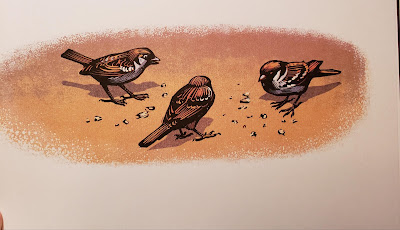
Lyra and Pan eventually make it back to school safely, but not before pondering the significance of it all. They realize all the birds were protecting them at the end, including the swan. After another brief discussion on the meaning of the events, they pilfer an apple pie, and reverently leave the crumbs on their windowsill for any hungry birds passing by.
- The Edition -
On the surface, the story seems pretty simply and straightforward, though as I said, the Illustrated Edition is an excellent format for it. I did a clumsy unboxing (unwrapping?) video of the illustrated Northern Lights as seen here, and Chris Wormell of course illustrated both. Here he continues his simple yet elegant line and sketchwork, some images bright and colorful, others a nice mix of light and shadow. I also am particularly fond of the pictures where we're behind the action - most often Lyra - with things framed from the back, as though the reader is conversely seeing events happen directly in front of them.
Also on a basic, functional level, the format works so well here because the story is so short. As much as I love the His Dark Materials Illustrated Editions thus far, their size can make them cumbersome, especially for those who like to carry books around (such as your Jordan Scholar here). Republic of Heaven knows how Wormell will manage something of the size and complexity of The Amber Spyglass. As it is, the font and the size of Lyra's Oxford makes for a pretty perfectly balanced book, and Pullman has always been an advocate for books as physical, crafted objects.
Plus, as I mentioned in my extensive retrospective of The Golden Compass film, this book feels very rooted in the same universe (multiverse? Pullmanverse?) as the full length novels. From the illustrations on the front cover, with a Lyra and Pan on the rooftops of Jordan gazing over at the dome of Radcliffe Camera as a shadowy black bird soars overhead in the color-drenched cloudscape, it does cry His Dark Materials. And to me, that is always going to be the most important thing.
(Grounding it in Oxford is certainly a sound way of doing this, that city so highlighted by and synonymous with Pullman's imagination, yet occupying real estate in reality as well)
As for the story itself though, it does contain more treasure within than it offers upon a first cursory glance. This is not surprising, as anyone who has studied Pullman's work on any level knows. The levels just go down and down - again like an open, eager, and receptive mind finds when delving into the mysteries of the alethiometer.
- The Analysis -

"Lyra and the Birds" does yield easily to a bit of a meta-commentary, just as Pullman's works like The Firework-maker's Daughter and Clockwork do. The most obvious meaning to be drawn here is how stories function and overlap and take on a life all their own. This is certainly a theme reflected strongly in the aforementioned Clockwork, which Pullman has cited as his favorite work. Much like Citagazze, the proverbial city of magpies in His Dark Materials, acts as a crossroads between worlds, "Lyra and the Birds" acts as a kind of literary crossroads between much bigger and bolder literary works.
But even within its own slender borders, its characters are constantly wandering in and out of other stories. All the little lost pictures and postcards and artifacts at the back of the book accentuate this idea, which is why Pullman brings them to our attention. All of this has "a history and a meaning," much as every elementary particle in the cosmos does.
(Actually, this line of thinking reminds me of a book I read once by the Zen teacher Thich Nhat Hanh - while exploring the concept of interdependence, he competently and compellingly interwove a single piece of paper with the entire history of the universe until a reader could all but see said paper as a still exploding extension of the Big Bang itself)
Pullman is one of no doubt many readers who has expressed interest and enthusiasm for the notion that characters impossibly live on before and after their tale in a particular film or novel is told. In "Lyra and the Birds" we get this feeling, as for instance the witch Yelena and her bird-daemon wander in from the events of The Amber Spyglass, crossing over into Lyra's Oxford. This of course leads us to Sebastian Makepeace, and the larger story of his son, and how he ties into Lord Asriel's story, and how that consequently shapes the story of Lyra in this book. Malcolm Polstead makes a cameo over halfway through this story too, now an affable professor who's personal story began in La Belle Sauvage and continues in The Secret Commonwealth. Makepeace will also cross over into that novel.
And not only is Pullman telling a story but, as usual, his characters are as well. The whole thing begins with Yelena's daemon Ragi telling a story in an attempt to manipulate all the action. Lyra is told stories about the rumors regarding Makepeace and his alchemy. Finally Makepeace tells the true story of what happened, thus ensuring he will have the ability to make it through the world of dead where the harpies will only honor honest tales.
Actually the biggest storytelling bridge in all of this is Lyra herself, and a good albeit brief look at her life after His Dark Materials was no doubt the big draw for this story when it was first published. We do learn a few interesting things about her developing personality, some of which point toward the next big novel chronologically, The Secret Commonwealth, and others which provide a counterpoint to it. Especially philosophically.
The first line of the book explains "Lyra didn't often climb out of her bedroom window these days." For one, she now has keys to the roof, given to her by the Porter so she could make sure the stonework and such wasn't deteriorating. For two, it also hints she has grown, matured, and been integrated into the adult world somewhat, no longer simply "the coarse and greedy little savage" readers were so magically introduced to in Northern Lights.
Of course, readers loved that "half-wild cat" version of Lyra, though keep in mind it was charming and lovable when she was eleven. It would be less so in "Lyra and the Birds," and much less so in The Secret Commonwealth. But she is still quick to join in the adventure when it announces itself, competently locating the alchemist and even lying like her old self when ferreting out information. Had the witch been an honest one like the others she'd known, she would have successfully helped her and her daemon and all would have been well.
Yet Yelena really was actually setting Lyra up, a fact she later chastised herself for not intuiting or even suspecting. She realized in retrospect how clear a trail she'd inadvertently left for everyone to follow. "Oh, how stupid she could be when she was being clever!" Lyra thinks to herself.
Makepeace tells her it wasn't her fault, fairly pointing out the witch had a good "six hundred years" head start on her. Still, Lyra is somewhat off her game, a trend which continues through the emotional explosion that erupts between her and Pantalamion years later. The aftermath of The Amber Spyglass has marked her deeply, particularly the loss of the love of her young life. Pullman tells us since she and Will parted, "The slightest thing had the power to move her to pity and distress; it felt as if her heart were bruised forever."
In point of fact, it is this emotional sensitivity that allows the bird-daemon Ragi to manipulate her - by playing on her heart and memories. Interestingly, it is her daemon Pan - arguably the part of her more linked to instinct and intuition - who feels she has become "too soft and warm-hearted."
So in the half dozen years or so between this and The Secret Commonwealth, it is quite plausible to assume that Lyra begins to overcorrect. By the time Pan leaves to find her absentee imagination, she seems to have partly walled herself off as a reaction to her naturally warm and open nature, at least intellectually. We see this in her attitude to romantic relationships, and her lack of close bonds in general, even with and especially to her own daemon.
While this is a very understandable response to all the drama endured in the first trilogy, it does speak volumes how she adopts such a cold, analytical, reductionist philosophy that may keep her safer from the world, but simultaneously completely alienates her from it. Lyra becomes so extreme about keeping her feet firmly planted on the ground in The Secret Commonwealth that she finds herself so depressed she can barely lift them at all.
Her attitude in that strongly contrasts with all the birds depicted here, as well as all they represent.
- The Symbolism -

In the Illustrated Edition, Pullman begins Lyra's Oxford with a page and a half note from the author. He recounts going for an afternoon walk in a local park in his own Oxford the summer he was crafting the finale of The Amber Spyglass. That summer countless starlings had begun gathering in the trees before taking flight, springing into the sky. As usual, Pullman lyrically describes their aerial acrobatics, writing it was "as if an invisible hand had taken the corner of an enormous tablecloth and flicked it sideways."
The experience marked him, as he remembered even years later how he had often felt as though he had been the only person alive witnessing the seemingly half-mystic event of those living, breathing whirlwinds in the air, those birds simultaneously both one and many.
Pullman even ends the author's note with an image of a raven, which has become his own personal stamp. He has always said a raven or a magpie or something from the jackdaw family would be his own daemon - some sort of bird irresistibly attracted to shiny objects and interesting trinkets to be gathered up and nested away, just as he himself does with stories and ideas.

Indeed, it is not hard to see how deeply the imagery and symbolism of birds has taken root in Pullman's creative psyche.
It is true an astute reader could probably fashion a solid drinking game based on the number of times Lyra and her father Lord Asriel are likened to cats in Northern Lights. But throughout His Dark Materials and into The Book of Dust, Lyra has attributes that Pullman also compares to a bird, noting her lightness or quickness or grace. Perhaps most memorably, when the eleven-year-old Lyra is learning to read the alethiometer, he says she feels "like a young bird learning to fly."
Bird references actually permeate His Dark Materials, whether it's the witch Ruta Skadi likening the rebel angels she meets to birds wheeling about the sky, or the scientist Mary Malone explaining how her mysterious Shadow-particles instantly "flock to your thinking like birds" (interestingly the mulefa later regard Mary as bird-like as well thanks to what they saw as her swift and darting attributes, though such a species would probably regard all humans in much the same way). Also the character of John Parry, aka Stanislaus Grumman, discovers to his amazement that he has a magnificent winged heron for a daemon when he crosses over into Lyra's world. Then this very daemon plays a critical role in pulling down pursuing zeppelins with the help of a flock of real birds.
And lest we forget, a similar scene takes place in The Secret Commonwealth, when Lyra is escaping through the Fens with the gyptian Gorgio Bragandt. Once again pursued by a menacing Magisterium zeppelin, they down it with the help of mysterious marsh lights or jacky lanterns or simply the heron or stork that kamikazes into the port engine.
Birds have quite naturally always been symbols of freedom and transcendence, untethered by the normal downward pull of gravity. Despite how he initially chalked up flying as just as a job to Serafina Pekkala, the Texas aeronaut Lee Scorseby later reflected on his true feelings about taking off in his trusty balloon. "Soaring upward, with a fair wind behind and a new world in front - what could be better in this life?"
Perhaps these sentiments resonate with a bit of Pullman's own heart. I seem to remember an article or an interview somewhere when he found himself "flying" as an author when writing in the realms of fantasy, as opposed to having "feet of clay" in laboring to write realism, never mind his artistic devotion to the latter. And wherever he is writing, traces of Romanticism and poetry are never far behind. In The Subtle Knife he even spins off a line worthy of Shelley or Keats regarding the "liquid music of the nightingale."
Birds flock and flutter throughout that literary movement everywhere, with seldom a Romantic poet not penning at least a line or two featuring skylarks. Perhaps most vividly with Shelley -

Lines such as these would not be too far out of place anywhere in Pullman's work.
And as most devotees of His Dark Materials know, when it came time to cite his three biggest creative influences on the trilogy, he cited John Milton, Heinrich von Kleist, and of course William Blake. Endlessly quotable, Blake had no shortage of lines and aphorisms conjuring up birds, his poems permeated with flying and soaring. One of the more popular is one Pullman is personally fond of and has quoted in numerous essays and interviews -

The Lyra in this story might ask much the same question, as she insists to Pan "Everything means something - we just have to find out how to read it."
Indeed, part of the meta commentary in His Dark Materials is framed around a young girl learning to read, albeit through the metaphor of the alethiometer. But even this symbolism extends further, as the witch consulate Lanselius points out in Northern Lights. After all, the alethiometer had been invented in Prague in the seventeenth century, which was a time "when symbols and emblems were everywhere. Buildings and pictures were to be read like books."
So as Lyra intuited here, reading could and perhaps should be broadened in the Pullmanverse to include Nature, if not life itself.
- The Meaning -
There are multiple ways to interpret this, but perhaps one of the best is juxtaposing it against the philosophy outlined in the fictional novel The Hyperchorasmians in The Book of Dust. Written by Gottfried Brandt, it had slowly but forcefully seduced Lyra. Its central catechism and commentary on life is "It was nothing more than what it was."
This stands in sharp contrast to the discussion that Lyra and Pan have at the end of this story. Specifically, how anything and everything is "nothing more than what it was," and how and where meaning itself finds form and expression. In a philosophical sort of mood, they muse about how it feels as though the birds were protecting them, it not even the city of Oxford -
"Things don't mean things as simply as that,"
Lyra said, uncertainly. "Do they? Not like mensa
means table. They mean all kinds of thing, mixed up."
"But it feels like it," Pan said. "It feels as if the
whole city's looking after us. So what we feel
is part of the meaning, isn't it?"
"Yes! It is. It must be. Not the whole of it, and
there's a lot more we don't even know is there,
probably ... Like all those meanings in the alethiometer,
the ones we have to go deep down to find. Things you never
suspect. But that's part of it, no question."
So this is an approach to life that is very much at the beating heart of both the Lyra trilogies. It's about going "deep down" into things - into being alive. It's about reading life not as one or two dimensional prose, but as the three and four and near-infinite dimensions nestled away inside great poetry. Shelley powerfully proclaimed that poetry "lifts the veil of familiarity from the world," but it also inherently extends said world in all directions when it comes to meaning and connection and significance.
And as Pan noted, what one feels is "part of the meaning," which echoes back on Pullman's constant insistence that poetry has to be read aloud to get the real meaning. In other words, it has to be spoken, sung, tasted, mainly experienced as fully and completely as possible - and only then does the meaning become clear, regardless of whether one intellectually understands it all or not (Pullman actually feels intellectual understanding sometimes hinders rather than helps when it comes to certain art forms. For the curious and interested, I discuss all this in considerable detail in my essay "Poe, Pullman, and Poetics").
Like with music, the meaning is in the reading and hearing of it. Trying to lure out meaning through abstract intellectual exercises is often like trying to taste food by eating a menu. This is what the overly rational and scholarly Lyra falls prey to in The Secret Commonwealth, not simply a malaise but a full on disenchantment with the world.
Many of these ideas are explored and channeled through the metaphor of Dust, and its relationship to us and reality as a whole. One of my favorite Pullman quotes about it is taken from an old interview in Readerville, which I have highlighted before -
Dust enriches us and is nurtured by us; it is
kept alive by love and curiosity and diligent enquiry
and kindness and patience and hope ... we are
partners and equals with Dust in the great
project of keeping the universe alive.
Perhaps the most important realization here is that the cosmos is participatory, as surely as reading a poem or an alethiometer is.
Lyra thinks of Oxford by the story's end as "The city, their city - belonging was one of the meanings of that, and protection, and home." And such a disposition can really be extended toward the entire universe, the universe we were born to and rooted in as surely as a tree. Because this universe, as one of the ghosts in The Amber Spyglass soundly reflects "is our true home and always was." If this hits one as too poetic or fanciful, then they should perhaps try to keep in mind that striking a completely detached pose of existential alienation from life, nature, and reality in general is a philosophical choice, not a scientific truth.
(For more on this, watch a video I referenced a few posts ago, Philip Pullman meets Iain McGilchrist)
But admittedly, such a holistic attitude to meaning requires a degree of creative relationship - an engagement between two realities, rather than an estrangement. This is meaning, but meaning rooted in being moved in a very deep and profound way by things, whether it be a young adult book series, or a flock of birds dancing through a blue sky.
As all this is not so easily reflected in prose, we will borrow the last line from one of Pullman's favorite Wordsworth poems to sum up the meaning of Lyra's Oxford -

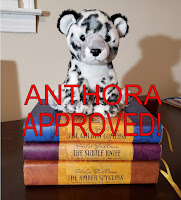
Lyra's Oxford Gift Edition is available for purchase here, but most importantly, what does my faithful snow leopard-daemon say about it?
And as Always
Stay Dusty My Friends
#HisDarkMaterials #TheBookOfDust #PhilipPullman #LyrasOxford
#BuildingTheRepublic #PullmanStudies #JordanScholarship
#InDustWeTrust #DownAndDusty #TheGreatProject


